


How to read a cosmetic label?
More and more brands are jumping on the bandwagon of "natural, bio, organic, or eco-friendly." Greenwashing is highly effective when it comes from multinationals or companies with huge marketing budgets, creating an image linked to […]

More and more brands are jumping on the "natural, bio, organic, or eco-friendly" bandwagon. Greenwashing is very effective when it comes from multinationals or companies with huge marketing budgets, creating an image linked to nature and sustainability while actually including synthetic or bioaccumulative substances in their composition.
Therefore, the best tool we as consumers have when buying a cosmetic is knowing how to interpret its labeling. At Herbera, we believe it is an obligation not to "confuse," to be transparent, and to provide all this information so that you can know for certain what you are buying, promoting conscious consumption.
Furthermore, the information that must appear on the labeling of all cosmetic products sold in the European Union is subject to European regulations, specifically Article 19 of the Cosmetics Regulation, and one of its main objectives is to guarantee transparency in information for consumers.
But... do you know how to interpret everything that appears on our packaging? Today, we are going to take you on a guided tour of our labeling, explaining all the information it contains!
1. LIST OF INGREDIENTS OR INCI:
The International Nomenclature of Cosmetic Ingredients (INCI) is a common international naming system that identifies every existing cosmetic ingredient perfectly and unequivocally.
It was developed in the United States in the 1980s by the CTFA (Cosmetic, Toiletry and Fragrance Association) and became mandatory in the European Union starting in 1998. You can access the cosmetic ingredient database on this European Commission page.
This nomenclature is mandatory for the labeling of all cosmetics, whether they are natural or conventional cosmetic products. It uses the scientific names of the ingredients, either in English or Latin, depending on their origin.
 It must be reflected on the container or at least on the packaging, and it must follow this rule: The list of ingredients must be in descending order of weight at the time of their incorporation into the cosmetic product; that is, in the INCI, ingredients are listed from highest to lowest concentration in the formula (up to concentrations of 1%). Those ingredients whose concentration is less than 1% are not required to be shown in that order.
Thus, we can conclude that an INCI is divided into 2 large groups: A first group of ingredients with a concentration greater than 1%, ordered from highest to lowest concentration. A second group, which would include those with a presence of less than 1%, arranged randomly.
Therefore, one key to analyzing the veracity of a cosmetic product is to intuit the 1% threshold. And to do this, you can be guided by identifying preservatives, pH adjusters, colorants, perfumes, or essential oils, such as: Sodium Benzoate, Potassium Sorbate, Benzyl Alcohol, Parfum, Phenoxyethanol (the latter is never used at Herbera). Thus, if the active ingredients touted by the product's name are at the beginning of the INCI, we can understand that those ingredients are in high concentrations. If, on the other hand, they are at the end, those ingredients are anecdotal, and therefore, the brand is selling smoke.
Furthermore, in the case of organic cosmetics, you may observe the presence of asterisks. When we use an asterisk, it means it is a certified organic ingredient. And if there are two asterisks, it means the ingredient is naturally present in certified organic essential oils.
We have published all the INCIs for our products on our website under the INGREDIENTS tab:
2. MAIN INGREDIENTS. To make it easier for the consumer—since not everyone has to know the name of a plant in Latin, which is how they are written in the INCI—on this part of the box we list the main ingredients present in each product.
3. ORIGIN OF OUR INGREDIENTS. We indicate whether the ingredients are of vegetable, mycological, mineral, and/or biotechnological origin. We also highlight products that are formulated with active ingredients in very high concentrations.
4. ORGANIC COSMETICS. We can state on our labeling that we are organic cosmetics because all our products contain an average of 90% ingredients of organic origin. Category I "Organic Cosmetic Product (Biological or Organic)." If our percentage of organic ingredients were lower, we would indicate in this section "natural cosmetics with a % of organic ingredients." There are some non-certified brands that indicate on their labeling that they are organic cosmetics even if only one of their ingredients is organic; this happens because they are not audited by another company that reviews their labeling. Therefore, the best guarantee to truly know what you are buying is for the brand to be certified.
5. NOMINAL CONTENT. Content at the time of product packaging. It can be indicated by weight or volume, in International System (SI) units. The "e" symbol appears when the product is packaged following one of the existing statistical control systems, the "average fill system," which is defined in the legislation. It guarantees greater veracity and transparency regarding the quantity of product packaged at the time of conditioning.
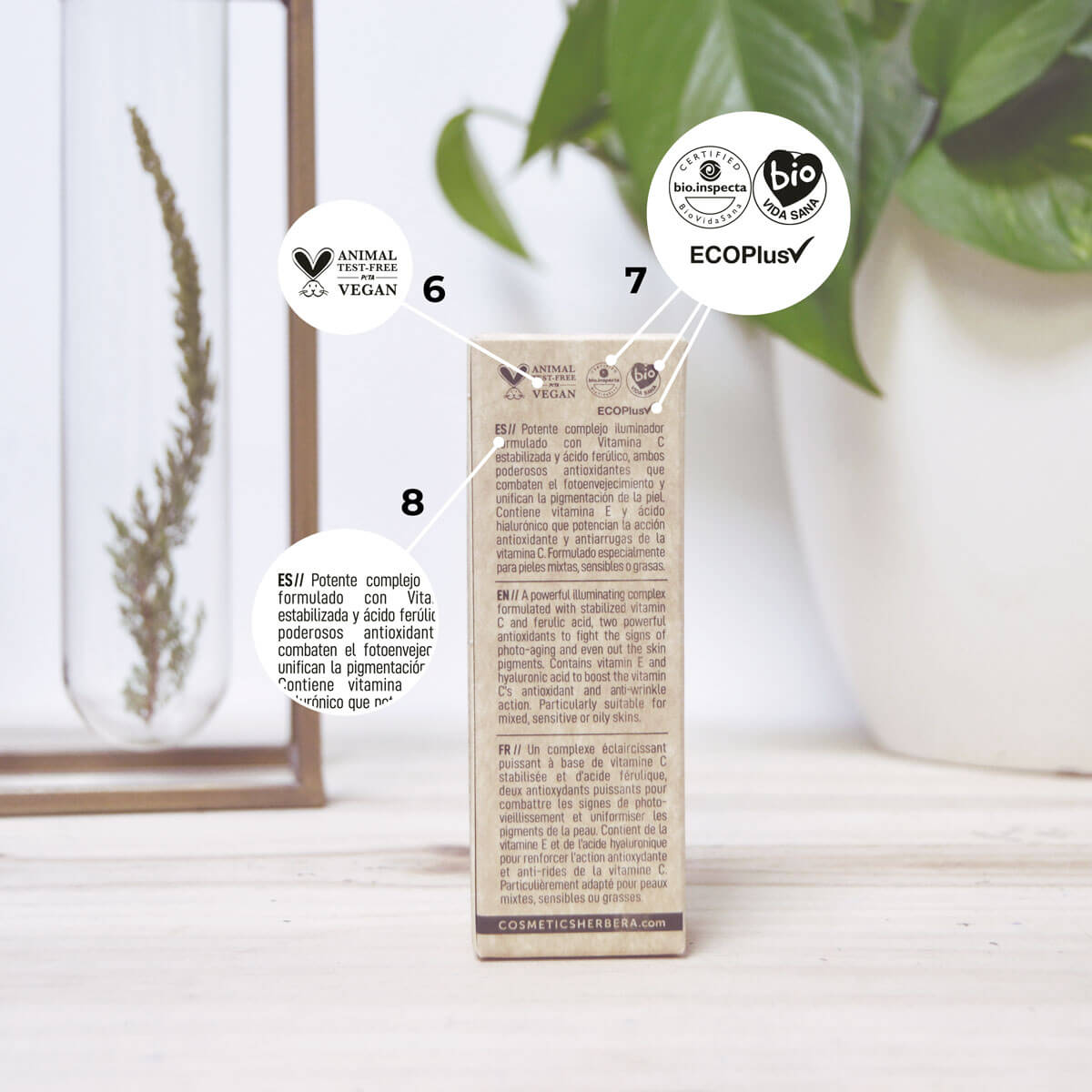 6. VEGAN CERTIFICATION. As you know, since 2016 we have been certified with PETA International as a cruelty-free and vegan brand because not only are we against animal testing, but we do not use any ingredients of animal origin. Herbera is 100% VEGAN.
7. ORGANIC CERTIFICATION. We are certified by BioInspecta under the BioVidaSana Standard for several reasons: first, because it is one of the most demanding standards in organic cosmetics. Second, because it is designed for small and medium-sized enterprises, prioritizing artisanal production, increased sustainability, and the local market. Finally, and most importantly, is their accessibility and professionalism. Our goal in getting certified is to provide consumer confidence so that they can be sure they are buying what the label says, and for this, the BioVidaSana Standard pays special attention to ensuring that the information the product offers the consumer is accurate and clear. Within the BioInspecta classification, we meet the highest standards in organic cosmetics with a percentage greater than 90% organic ingredients in most of our products (Category 1), certified with the Ecoplus Seal, a seal awarded to companies that manufacture with the highest possible percentage of organic ingredients.
8. PRODUCT DESCRIPTION. Where we summarize the properties and main components of our cosmetic in a clear and precise way. You can find them in Spanish, English, and French.
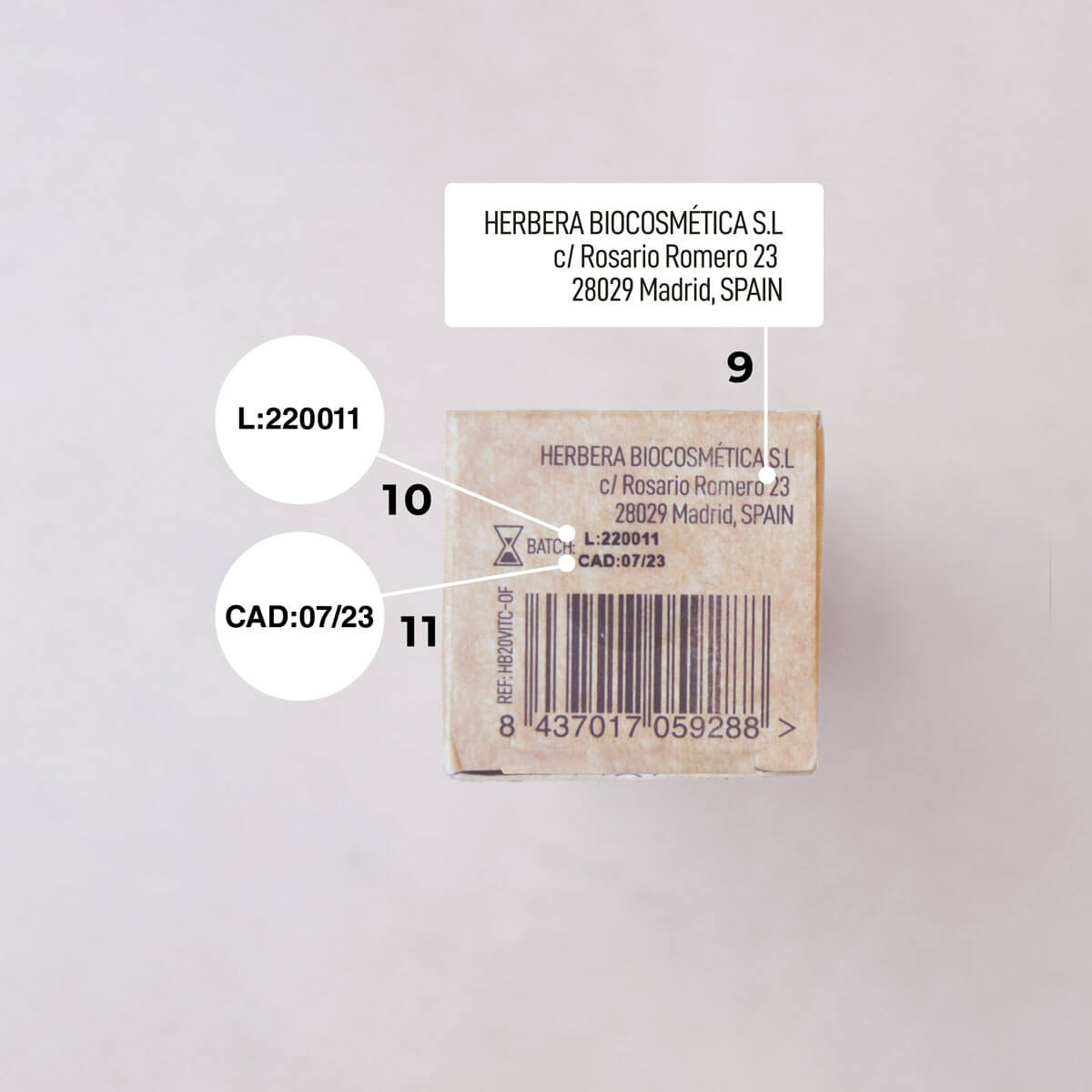 9. NAME AND CONTACT OF THE PERSON RESPONSIBLE FOR PLACING ON THE MARKET. The name or company name and address of the responsible person must appear (physical address, an email address is not accepted). In the case of imported cosmetics, the country of origin must also appear. On this side, you will find how to locate us through our website, and on the bottom flap of the box, you have all our company details.
10. LOT OR BATCH NUMBER: It is also found on the bottom flap of the box and allows for product traceability. If the dimensions of the container do not allow its mention, it will only appear on the packaging.
11. BEST-BEFORE DATE AND/OR PAO: Regulation 1223/2009 states: "The date of minimum durability shall be clearly expressed and shall consist of either the month and the year or the day, month, and year, in that order." The regulation also adds that "the indication of the date of minimum durability shall not be mandatory for cosmetic products with a minimum durability of more than thirty months. For such cosmetic products, the period after opening during which the product is safe and can be used without harm to the consumer shall be indicated." At Herbera, we prefer to always indicate the best-before date rather than the PAO because if only a PAO is given, the product could have been manufactured 30 months ago and could even be expired, and the customer would not have its actual expiration date.
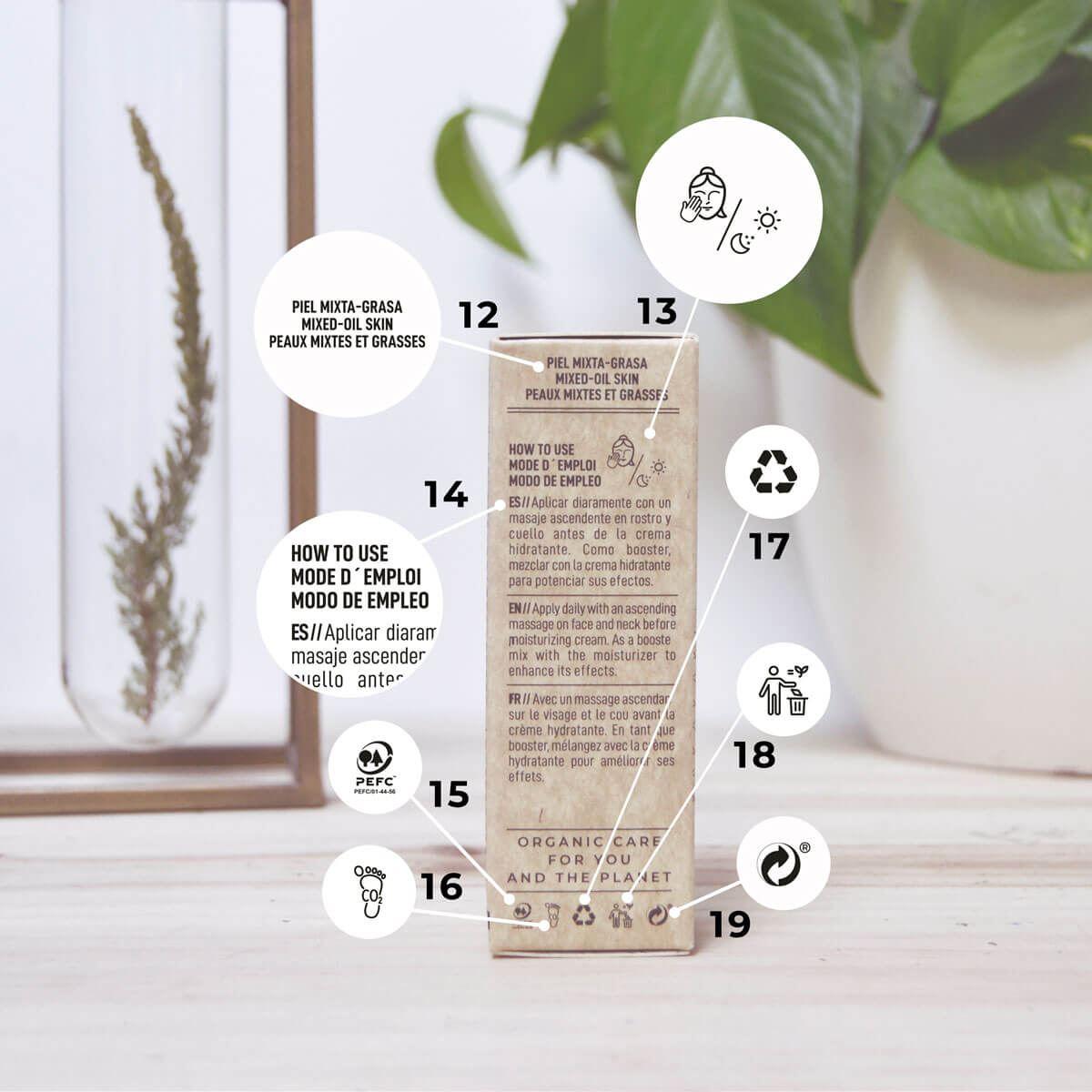 12. SKIN TYPE FOR WHICH THE PRODUCT IS INTENDED. Whether it is a product formulated for combination, oily, dry skin, or all skin types.
13. INDICATIONS: Whether it is for facial or body use and if it should be applied only at night or morning and night.
14. DIRECTIONS FOR USE: We tell you how to apply the product and any particular precautions for use, if any.
We also have a section for other certification seals:
15. PEFC (Spanish Forest Certification System PEFC) which guarantees that the paper, cardboard boxes, and shipping envelopes we use at HERBERA come from sustainable forests.
16. OFFSET CARBON FOOTPRINT. The CO2 emissions generated for the production and sale of this product have been offset through a forest regeneration project in the Sierra de Gredos area. If you want to know more about the project we participate in, click here.
17. REDUCE, RECYCLE, AND REUSE. This is the symbol indicating that the materials used to make a product can be recycled.
18. TIDYMAN. This voluntary symbol encourages us to dispose of waste properly and to be responsible for the environment.
19. ECOEMBES. A company that monopolizes the household packaging waste management system in Spain, which claims to be non-profit and whose declared recycled packaging rates are increasingly being questioned. For any brand that sells a product in packaging—understanding packaging as also a box or a paper bag—the legislation requires us to pay Ecoembes so that they are the ones who collect money from companies. Part of that money goes to the autonomous communities for the management of recycling bins, and another part of the proceeds is allocated to advertising and marketing for Ecoembes itself. The "green dot" symbol is the one normally used and indicates that the manufacturer is complying with the law on packaging and packaging waste.
And finally, we have left the front of the box for last; here are its components:
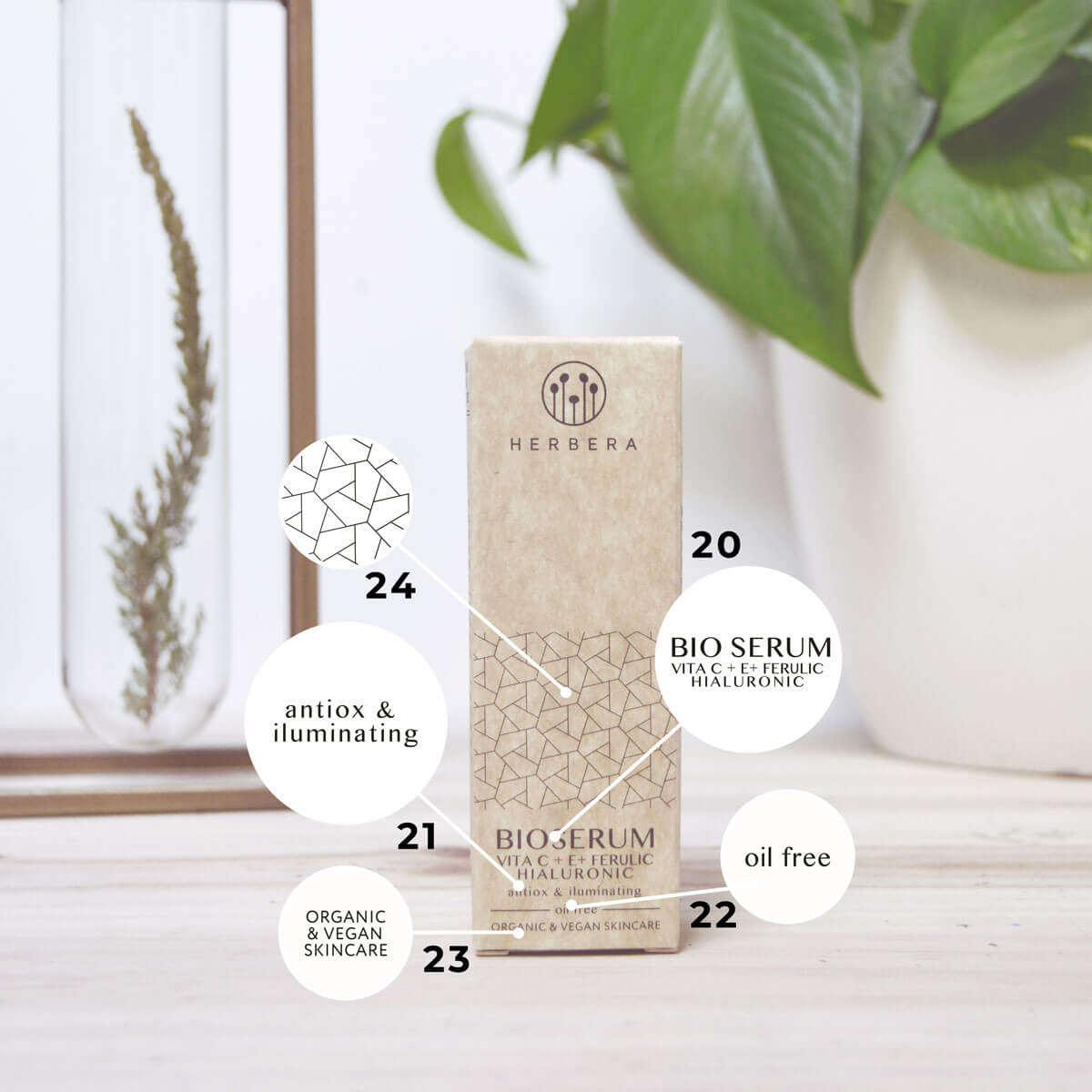 20. PRODUCT NAME: In this case, Bio Serum Vitamin C+E+Ferulic+Hyaluronic
21. PRODUCT FUNCTION: In this case, Antiox & illuminating.
22. OIL FREE or NUTRITIVE REPAIR: These sometimes appear on our labeling depending on whether a formula is oil-free or, on the contrary, has a more nourishing texture.
23. ORGANIC & VEGAN SKINCARE. Our brand slogan, which indicates that it is organic and vegan cosmetics.
24. HERBERA PATTERN. Finally, we tell you some interesting facts about our patterns. They are design elements throughout our cosmetics and vary depending on the product. For example, for a cream texture, the pattern is a kind of dots that are actually the sprouts from the Herbera logo; if it is an oil, the pattern is circular; cleansing products share a polygon; and the pattern for serums varies according to the active ingredient.
Extra visual information for HERBERA, where we always try to make quality, innovation, and design go hand in hand.
I hope you find this information useful!


